In the wake of World War II, Japan’s avant-garde art scene witnessed the birth of a revolutionary collective that would redefine the boundaries of artistic expression. The Gutai Art Association, founded in 1954 by Jiro Yoshihara in Osaka, emerged as a defiant response to the rigid conventions of traditional art. Unlike Western abstract expressionism, which often prioritized gesture and emotion, Gutai artists sought to dissolve the barrier between the artist’s body and the materials they manipulated. Their manifesto, penned in 1956, declared a bold new ethos: "Do what no one has done before!" This was not mere provocation—it was a philosophical stance that positioned the physical act of creation as a conversation between human agency and the inherent qualities of matter.
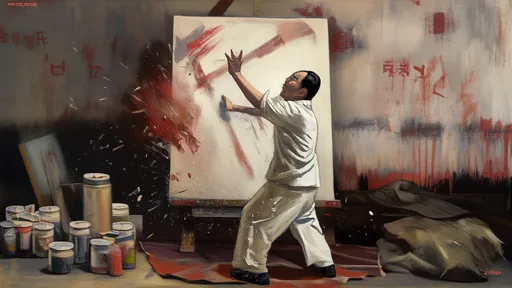
The Gutai movement’s most striking feature was its insistence on direct engagement with materials in ways that celebrated their raw, unmediated properties. When Kazuo Shiraga suspended himself from ropes to paint with his feet, or when Saburo Murakami hurled himself through paper screens, these were not performances in the contemporary sense but ritualistic explorations of material resistance. The artists treated paint, mud, broken glass, and even electricity as collaborators rather than passive mediums. Atsuko Tanaka’s iconic "Electric Dress" (1956), a wearable sculpture of flickering light bulbs, exemplified this ethos—the human form became both canvas and conductor, literally illuminated by its interaction with technology.
What set Gutai apart from other postwar movements was its rejection of metaphor. Where European art often used abstraction to signify trauma or existential angst, the Japanese group embraced concrete physicality as an end in itself. Shiraga’s mud paintings weren’t about decay; they were decay in real time. Motonaga Sadamasa’s water-filled vinyl tubes installed in nature didn’t represent harmony—they created actual, shimmering bridges between organic and synthetic worlds. This literalism extended to their exhibitions, which transformed entire landscapes into temporary interventions. The 1955 "Outdoor Gutai Art Exhibition" in Ashiya Park featured works that responded to wind, rain, and pedestrian interaction, anticipating relational aesthetics by decades.
The movement’s radical materialism carried implicit political undertones. In occupying a war-torn Japan still under American cultural influence, Gutai’s emphasis on primal creativity functioned as both rebellion and healing. Yoshihara’s insistence that "the human spirit and material shake hands" reflected a desire to rebuild national identity through artistic autonomy. Their childlike experiments—splashing paint, burning objects, imprinting bodies on clay—reclaimed the prelinguistic joy of making, offering an antidote to the era’s ideological fractures. Critics initially dismissed them as destructively naive, but their intentional embrace of ephemerality (most early works were destroyed after documentation) now reads as a prescient critique of art-market commodification.
Contemporary artists continue to mine Gutai’s legacy, particularly its interrogation of agency in material encounters. The movement’s influence surfaces in the durational performances of Marina Abramović, the bio-art of Anicka Yi, and even in algorithmic art that treats code as a collaborator. Yet few have matched Gutai’s fearless physicality—their willingness to let materials "speak back," whether through the viscosity of paint or the fragility of paper. As digital creation increasingly dominates global art practice, the group’s insistence on haptic, risk-laden dialogue feels more urgent than ever. Their work stands as a testament to art’s capacity to reveal the alchemical moment when human intention meets the stubborn, glorious resistance of the physical world.
By /Aug 11, 2025
By /Aug 11, 2025
By /Aug 11, 2025
By /Aug 11, 2025
By /Aug 11, 2025
By /Aug 11, 2025

By /Aug 11, 2025

By /Aug 11, 2025
By /Aug 11, 2025
By /Aug 11, 2025

By /Aug 11, 2025
By /Aug 11, 2025
By /Aug 11, 2025
By /Aug 11, 2025
By /Aug 11, 2025
By /Aug 11, 2025
By /Aug 11, 2025
By /Aug 11, 2025

By /Aug 11, 2025
By /Aug 11, 2025