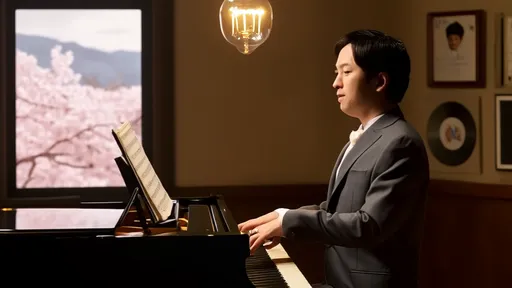
Joe Hisaishi’s compositions are more than just accompaniments to film; they are philosophical explorations rendered in melody. His work, particularly in collaboration with Hayao Miyazaki, transcends the boundaries of conventional film scoring, becoming a language of its own. The interplay between silence and sound, the tension between minimalism and grandeur, and the emotional resonance of his themes all point to a deeper, almost meditative understanding of human existence. Hisaishi doesn’t merely write music—he crafts sonic landscapes that invite listeners to reflect on life’s fleeting beauty and its inherent melancholy.
The Silence Between the Notes
One of the most striking aspects of Hisaishi’s philosophy is his reverence for silence. In a world saturated with noise, his compositions often embrace pauses as actively as they do notes. The spaces between sounds are not empty; they are pregnant with meaning. This approach mirrors Eastern philosophies, particularly Zen Buddhism, where emptiness is not a void but a space for potential. Tracks like "Path of the Wind" from My Neighbor Totoro exemplify this—a simple piano melody, unhurried and uncluttered, allows the listener’s mind to wander and project their own emotions onto the music. Hisaishi’s restraint speaks volumes, suggesting that what is left unsaid can be as powerful as what is articulated.
Nature as a Musical Metaphor
Hisaishi’s music frequently draws from the natural world, not just as inspiration but as a foundational element of his compositional philosophy. The ebb and flow of his melodies mimic the rhythms of wind, water, and seasons. In Princess Mononoke, the orchestral swells and delicate woodwind passages evoke the untamed wilderness, while the recurring motifs in Spirited Away mirror the fluidity and unpredictability of rivers. This isn’t mere imitation; it’s a dialogue between humanity and nature. Hisaishi seems to argue that music, like nature, is a force that exists beyond human control—it can be channeled but never fully mastered.
The Weight of Nostalgia
Nostalgia permeates Hisaishi’s work, but it is never saccharine or sentimental. Instead, it carries a bittersweet weight, acknowledging the passage of time without resignation. Pieces like "One Summer’s Day" or "The Rain" from Kikujiro are imbued with a longing that feels universal, as if the music itself is mourning the transience of joy. This philosophical undercurrent aligns with the Japanese concept of mono no aware—the gentle sadness of impermanence. Hisaishi’s genius lies in his ability to make this melancholy uplifting, transforming it into a celebration of moments that, though fleeting, are eternally preserved in memory.
Collaboration as Alchemy
His partnership with Miyazaki is often described as alchemical, but the philosophy behind it is rooted in mutual respect for the unspoken. Hisaishi’s scores don’t just support Miyazaki’s visuals; they expand them, adding layers of emotional and philosophical depth. The music for Howl’s Moving Castle, for instance, elevates the film’s themes of war and redemption by weaving waltzes and martial rhythms into a tapestry that feels both whimsical and grave. This synergy suggests a shared belief in art’s power to convey complex truths without explicit explanation—a philosophy where trust in the audience’s intuition is paramount.
Minimalism and Emotional Maximalism
Paradoxically, Hisaishi’s simplest compositions often carry the greatest emotional weight. A single recurring piano motif, as in "The Legend of the Wind" from Nausicaä of the Valley of the Wind, can evoke a spectrum of feelings—hope, despair, wonder—without relying on orchestral excess. This minimalist approach reflects a philosophical stance: emotion is not amplified by complexity but by authenticity. Hisaishi’s music strips away the unnecessary, leaving only what is essential to stir the soul. In doing so, it becomes a mirror, reflecting the listener’s inner world back at them.
Legacy and the Unfinished Symphony
Hisaishi’s work resists closure. Even his most triumphant pieces, like "Merry-Go-Round of Life" from Howl’s Moving Castle, carry a whisper of incompleteness, as if the music acknowledges that life’s stories are never fully told. This openness aligns with his philosophical inclination toward perpetual becoming rather than static being. His compositions don’t conclude; they linger, inviting reinterpretation with each listen. In this way, Hisaishi’s philosophy extends beyond the notes—it is an invitation to engage with the unfinished symphony of existence itself.

By /Aug 13, 2025

By /Aug 13, 2025

By /Aug 13, 2025

By /Aug 13, 2025

By /Aug 13, 2025

By /Aug 13, 2025

By /Aug 13, 2025

By /Aug 13, 2025

By /Aug 13, 2025

By /Aug 13, 2025

By /Aug 13, 2025

By /Aug 13, 2025

By /Aug 13, 2025

By /Aug 13, 2025

By /Aug 13, 2025
By /Aug 13, 2025

By /Aug 13, 2025

By /Aug 13, 2025

By /Aug 13, 2025

By /Aug 13, 2025